
Why Water Pressure Drops When Two Taps Run at Once
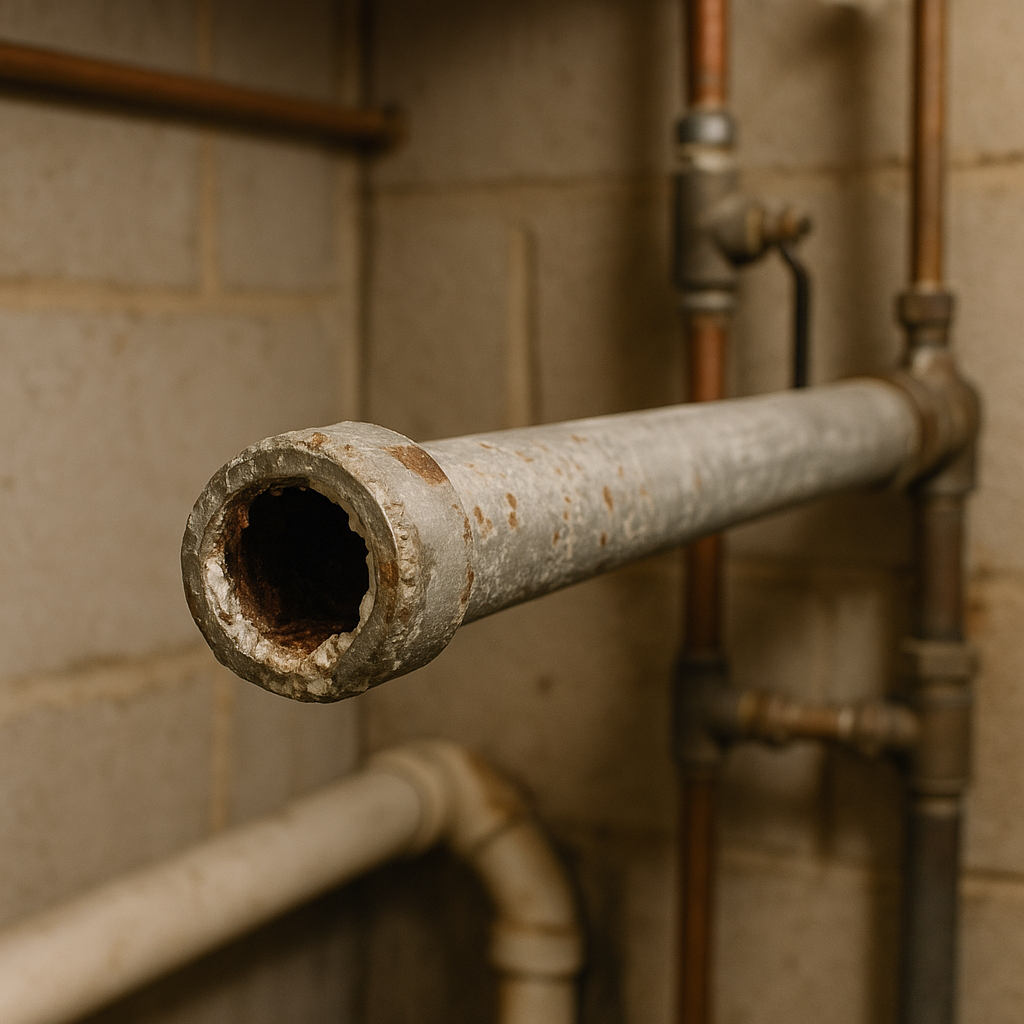
Quick Answer: When two fixtures share the same supply and one steals flow from the other, the pressure you feel drops. It is almost always a flow problem, not a pressure problem: narrowed pipes, a misadjusted pressure-reducing valve, or scale-clogged parts can feed one fixture fine but cannot serve two at once. Where the drop shows up tells you which one it is.
You are mid-shower when someone starts the kitchen sink, or a toilet refills, and the water at your feet goes from a steady spray to a sad trickle. It comes back the moment they shut off. On its own, each fixture works, so nothing feels broken, yet the house clearly cannot run two things at the same time without one robbing the other. That single symptom, two taps fighting over the same water, points at a small set of causes, and the trick is reading where and when the drop happens so you know which one you are dealing with.
First, Force Versus Volume
Before chasing any fix, it helps to separate two things people lump together as "pressure." One is the force pushing the water, and the other is the amount of water available to move. They fail in different ways and for different reasons.
Think of the supply to your house like a highway. Pressure is how fast the cars are allowed to go. Flow is the number of lanes open. If your plumbing has plenty of pressure but the pipe has narrowed to a single lane, one car cruises through fine, but ask two cars to pass at once, and they jam. That jam is what you feel when the shower fades the instant a second tap opens. The force did not disappear; the road just ran out of room to carry the second demand.
This distinction matters because a true low-pressure problem shows up even when only one fixture is running: weak everywhere, all the time. A two-tap drop is different. Each fixture is fine alone and only struggles under shared load, which is the signature of a flow limit somewhere between the meter and those two fixtures. Naming the problem correctly is what keeps you from adjusting a valve that was never the issue.
Narrowed Supply Pipes: The Most Common Culprit
The pipe carrying water to a group of fixtures has a fixed inside diameter, and that diameter sets a ceiling on how many gallons per minute can pass. When a house is plumbed correctly, that ceiling sits comfortably above what two fixtures need at once. Two things quietly lower the ceiling over time.
The first is the pipe material itself. Older homes were often run in galvanized steel, and the inside of that steel does not stay smooth. It corrodes and accumulates mineral buildup that grows inward year after year, so a pipe that started with a wide bore ends up with an opening far smaller than the fitting size would suggest. It can still push enough water for one fixture, but the moment a second one opens, the narrowed channel simply cannot split its limited flow two ways, and both fixtures sag.
The second is a branch line that was undersized from the start, or a long run feeding several fixtures off one skinny pipe. Even in good copper or plastic, if a half-inch line is asked to serve a shower and a nearby sink at the same time, physics wins and the shared demand outruns what the pipe can deliver. This is why the problem clusters in one part of the house: fixtures sharing that one strained branch fight each other, while fixtures on a better-sized line run fine.
Scale, Aerators, and Cartridges
Where the local water is very hard, this cause carries extra weight. Hard water is loaded with dissolved calcium and magnesium, and every time it sits or heats up, some of that mineral drops out and cakes onto whatever it touches. Over the years, it lines the inside of pipes and, more visibly, clogs the small parts at each fixture.
The aerator, the little screened tip that screws onto a faucet spout, is a common choke point. It has a fine mesh sized to shape the stream, and scale plugs those holes until the faucet dribbles. The same happens inside a faucet or shower valve cartridge, where narrow passages meter the water, and mineral crust slowly closes them off. When these parts are half-blocked, a fixture that was already sharing a strained line has even less margin, so the two-tap drop that used to be mild becomes severe. Aerators and many cartridges are serviceable, and clearing them can restore a surprising amount of flow at the fixtures that feel worst.
The Pressure-Reducing Valve and the Main
Not every cause is a narrowed pipe. Some houses have a pressure-reducing valve, or PRV, a bell-shaped fitting on the main line just past the meter that deliberately maintains a safe pressure throughout the home. When it is set correctly, it is invisible. When it drifts low or starts to fail internally, it caps the house tighter than it should, and that low ceiling is exactly the kind of thing you never notice with one fixture but feel hard the moment a second demand piles on.
A partially closed main shutoff does the same thing in a cruder way. If the main valve, where water enters the house, or the meter-side stop, is not fully open, it throttles everything downstream. The house limps along on one fixture and chokes on two. It is worth confirming those valves are turned fully open before assuming the problem is buried in the walls, because a half-turned valve is the cheapest fix on this whole list.
Water Heaters, Softeners, and Filters
Two more restrictions sit on specific paths rather than the whole house. The first is on the hot side only. Water bound for a hot tap detours through the water heater, its inlet and outlet nipples, and usually a longer stretch of pipe than the cold run. In hard-water country, the tank and those nipples collect scale, adding a restriction that the cold side never sees. So if your two-tap drop shows up mainly when both demands are hot, the hot path and the heater are the places to look.
The second is any whole-house treatment gear: a water softener or a sediment or carbon filter plumbed into the main. These are common where the water is hard and heavily treated at the source. When a filter cartridge loads up with sediment, or a softener's control valve is undersized or fouled, it becomes a bottleneck that the entire house has to pass through. Everything works acceptably at low demand, then chokes when two fixtures pull at once, because the restricted device cannot pass enough combined flow.
Reading Where the Drop Happens
Because the causes leave different fingerprints, a little methodical testing narrows it down fast. The core questions are three: does it happen only on hot, only on one branch, or across the whole house?
Start by running two fixtures far apart, on different branches, and watch whether both sag. Then run two on the same branch, close together. If the drop only appears when both fixtures share a branch, the trouble is that branch: its pipe size, its material, or a local clog in an aerator or cartridge on it. If instead the drop shows up no matter which two fixtures you pick, the restriction sits upstream where all water passes, which points at the main, the PRV, the meter, a whole-house filter, or an undersized service line feeding the property. Layer in the hot-versus-cold check, and you can often tell a local, single-fixture clog apart from a house-wide, under-load limit before anyone opens a wall.
What the Fixes Look Like
The lightest fixes match the lightest causes. A clogged aerator unscrews and soaks clean, and many cartridges can be pulled, cleared of scale, or swapped. If those parts were the choke point on a shared branch, this alone can end the fighting. Confirming that the main and meter valves are fully open belongs in this same easy tier.
Deeper causes call for a plumber. A PRV set too low can be tested and adjusted, and one that has failed internally is replaced, restoring the ceiling for the whole house. Corroded galvanized supply lines do not recover because the buildup is inside the steel; the durable answer is repiping those runs in modern material with a full-size bore. An undersized branch can be upsized to carry both fixtures. Servicing or resizing a softener or filter clears that bottleneck. These jobs involve cutting into pressurized supply lines and setting valves that govern the whole home, so they are pro work, not a weekend experiment.
Frequently Asked Questions
Pressure is the force, measured in psi, that pushes water through the system, while flow is the volume, measured in gallons per minute, that actually arrives. The two-tap fade is almost always a flow limit: narrow pipes cannot split their gallons between two open fixtures, so each weakens. True low pressure is different because it starves even a single tap running alone, so if one fixture is already weak, you are looking at pressure, not the shared-flow problem.
In houses plumbed with it, yes. Galvanized branch lines commonly last only about 40 to 50 years before the inside bore chokes with rust and scale, so age alone is a strong tell that the pipe is at its limit. The hot lines corrode fastest because heat speeds the scaling, which means hot-side flow usually weakens first, even when the cold branches still carry two fixtures fine. Once you know roughly how old the runs are, that timeline helps you judge whether repiping is overdue rather than optional.
A PRV sets the ceiling for the whole home's pressure, so when it is adjusted too low or failing internally, it caps every fixture tighter than intended. You rarely notice with one tap, but adding a second demand exposes the shortfall, and both fade together. A plumber can put a gauge on the system, then adjust the valve back into range or replace it if the internals are worn, which lifts the ceiling for both taps at the same time.
Two hot-only culprits sit beyond the general scale story. A broken dip tube, or a hot-water recirculation loop, adds restriction on the hot side that the cold path never carries. On top of that, a scaled water-heater nipple can narrow the hot bore to a fraction of its size while the cold side stays wide open, so a hot-plus-hot draw collapses while cold-plus-cold barely flinches. When the fade tracks the hot taps specifically, start at the heater's connections rather than the main.
They can, and both give you a way to test them. A sediment filter cartridge should be swapped on a schedule, often every few months, once it loads up with grit, so a cartridge left in far too long is a prime suspect. A softener also has a bypass valve you can open to route water around the unit; if the flow jumps once you bypass it, the softener itself was the bottleneck. That single check distinguishes between a fouled treatment device and a restriction buried elsewhere.
Put a pressure gauge on an outdoor hose bib and read it twice: once with everything shut off, then again with a tap running. Near-normal static pressure that collapses under flow confirms a flow or pipe-size limit rather than a truly low reading from the street. From there, open two fixtures on different branches, then two on the same branch; a sag confined to the shared branch is local, while a sag on any pairing is upstream. Together, the gauge reading and the branch test tell you whether to look at one fixture or the whole system.
Book a flow and pressure diagnosis — pinpoint the real restriction and get both taps running strong again. Adaven Plumbing serves Las Vegas and the surrounding area. Call (702) 766-3320 for a free assessment.