
Garbage Disposal Hums but Won’t Spin: The 5-Minute Fix
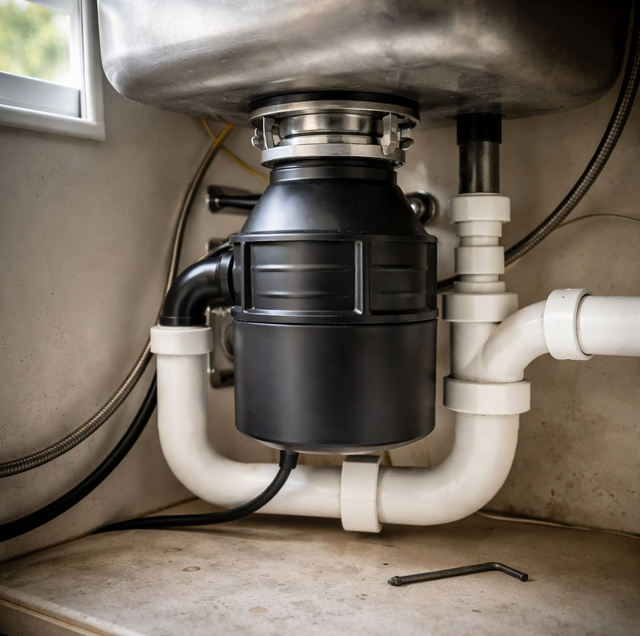
Quick Answer: A humming disposal that won't spin is jammed, not dead. Something is wedged between the spinning flywheel and the fixed grind ring, stalling the motor. Cut power at the switch or breaker, use the hex wrench in the bottom socket to rock the flywheel free, remove the object, then press the red reset button. Never reach into the drain with power on.
You flip the switch and hear a low, steady hum, but nothing grinds. The sink just sits there while the disposal buzzes like a trapped insect. That sound is actually good news compared to silence, because a hum tells you the unit still has power. What it has lost is motion. The motor is trying to turn, and something is physically blocking it.
Understanding what that hum means changes everything about how you approach the fix, so it helps to know what is happening inside the housing before you touch a single tool.
What the Hum Is Actually Telling You
Inside a garbage disposal, there is no set of spinning blades as people imagine. There is a flat metal plate called the flywheel, and mounted on it are two blunt metal lugs called impellers. These impellers swing outward on pivots as the flywheel spins, throwing food against a stationary ring of teeth on the wall of the chamber. That fixed ring is the grind ring. Grinding happens when food is flung against those teeth at speed, not when a blade slices it.
A jam happens when something lodges in the narrow gap between a swinging impeller and the grind ring. Once that gap is blocked, the flywheel cannot rotate. The motor still receives power and still tries to turn, but it is stalled against a solid obstruction. A stalled motor draws a heavy load of current and heats up quickly, which is why that hum should never be left running. Within seconds you are pushing the motor toward its thermal limit.
This is the same helpless strain a car feels when you press the gas with the parking brake locked down: the engine roars, fuel burns, but the wheels stay put and nothing but heat comes of it. The disposal is in that exact bind, and every second of humming adds heat it cannot shed.
So the goal is simple. Free the flywheel so it can spin again, clear whatever caused the jam, and reset the motor. The order matters, and the very first step is not optional.
A stalled disposal draws a heavy load of current and overheats within seconds, and the impellers and grind teeth stay sharp even when the motor is off. Cut power at both the wall switch and the breaker before you go near the chamber, and never reach in with your hand. Use a flashlight to look, and tongs or a wooden handle to clear the jam.
Step One: Kill the Power Before Anything Else
Turn off the switch, then cut the breaker: Flip the wall switch that controls the disposal to off. That alone is not enough. Go to the electrical panel and switch off the breaker that feeds the disposal or the kitchen circuit. You want the unit dead at two points, because a wall switch can fail or be bumped back on by someone who does not know you are working underneath.
Never put your hand into the disposal chamber. Even with the power off, the impellers and grind teeth are sharp enough to cut you, and the whole point of the double shut-off is to guarantee the motor cannot start while your fingers are near it. If you need to see inside, use a flashlight and look; do not feel around blindly.
Once the power is confirmed off, you can work on the jam from either the bottom or the top of the unit.
Step Two: Free the Flywheel From the Bottom
Most disposals have a hex-shaped socket in the center of the underside, and many ship with a small hex wrench (an Allen wrench) that fits it. If you cannot find the original, a standard 1/4-inch hex key usually fits.
Insert the wrench and rock it back and forth: Push the hex wrench into the bottom socket until it seats, then work it clockwise and counterclockwise in short strokes. You are manually turning the flywheel, which shifts the impellers and often crushes or dislodges whatever wedged them. Keep rocking until the wrench swings a full, free rotation in both directions with no catch. That free spin is your sign the flywheel is loose again.
Step Three: Rock It Free From the Top
If the unit has no bottom socket, or the wrench will not budge it, you can work from inside the drain instead, always with the power off.
Use a disposal wrench or a wooden handle, never your hand: A disposal wrench (sometimes sold as a jam wrench) drops into the chamber and grips the flywheel from above. If you do not have one, the handle of a wooden spoon or a short wooden broom handle works. Wedge the tool against an impeller and lever it in both directions to rotate the flywheel. Wood is the right choice because it will not spark, will not damage the metal, and gives you a firm grip without putting skin near the teeth.
Once the flywheel turns freely, look inside with a flashlight and fish out whatever caused the jam using tongs or pliers. Common culprits are a bottle cap, a chunk of bone, a wad of fibrous peel, or a spoon that slipped in unnoticed.
Step Four: Press the Reset Button
When a disposal motor overheats or stalls, an internal safety called the overload protector trips and cuts power to the motor to save it from burning out. That trip is what leaves you with a unit that has stopped, and it must be reset by hand.
Find the red button on the bottom of the unit and press it in: Reach under the sink and feel for a small red or black button on the underside of the disposal. If it has popped out, push it firmly until it clicks and stays in. If it will not stay pressed, the motor may still be too hot, so wait ten to fifteen minutes for it to cool, then try again.
With the jam cleared and the button reset, restore power at the breaker, turn on cold water, and flip the switch. A freed disposal should spin up and run smoothly.
The Different Problem: A Total No-Hum
A jam and a dead unit are two different faults, and the sound tells them apart. If you flip the switch and hear nothing at all- no hum- that is not a jam. Your motor is not even getting power, so there is nothing to free.
A silent disposal usually points to one of three things. The overload protector may be tripped, so press the reset button first. The unit may have lost power at the breaker, so check the panel for a tripped breaker and confirm that any nearby GFCI outlet has not tripped. Or the wall switch itself may have failed. Wiring faults, a bad switch, and a burned-out motor are electrical repairs, not DIY drain work, and they belong to a plumber or electrician.
What Causes These Jams in the First Place
Knowing what wedges a flywheel helps you keep it from happening again. Disposals stall on a predictable short list of offenders:
- Bones and hard pits act like ball bearings, rolling into the gap and locking the impeller solid.
- Fibrous peels such as celery, corn husks, artichoke, and onion skins wrap into stringy ropes that bind the flywheel.
- Glass and metal, including a stray bottle cap, a twist tie, or a dropped utensil, jam instantly and can chip the grind ring.
- Grease and fat poured in warm slide down, then harden as they cool into a stiff paste that gums up the chamber and slows the flywheel.
Running cold water while you grind, feeding scraps in small amounts, and keeping bones, pits, and fats out of the drain prevents most of these stalls.
When to Stop and Call a Plumber
Some symptoms mean the fix is past the point of a hex wrench. Stop and call a professional if any of these show up.
The reset button will not stay in after the unit has cooled. That points to an electrical fault or a failing motor, not a jam. Water leaks from the bottom of the unit or around the sink flange, which signals a cracked housing or a failed seal that clearing a jam will not solve. A burnt or electrical smell, which means the motor windings may already be damaged. The flywheel stays locked no matter how hard you rock it, suggesting a seized motor or a shard driven deep into the grind ring.
Forcing a seized unit can crack the housing or damage the motor beyond repair, so when the simple fix doesn't work, the safe move is to bring in someone who can open it up properly.
Frequently Asked Questions
Sometimes, but poorly. The grind chamber sits above the drain trap, so water can seep past a jammed flywheel and drain slowly even when the unit will not spin. If the sink also backs up or drains sluggishly, you may have two problems at once: a jam in the chamber and a separate clog in the trap or drain line below the disposal, which needs to be snaked separately.
Only a few seconds of safe margin. A stalled motor can reach damaging temperatures within roughly five to ten seconds because all the electrical energy converts to heat instead of motion. The overload protector is designed to trip before permanent damage, but repeatedly forcing a jammed unit to hum defeats that protection and can cook the windings, so shut it off the instant you hear a hum with no grinding.
No. Chemical drain cleaners do nothing for a mechanical jam because the flywheel is blocked by a solid object, not a soft clog. Worse, the caustic liquid pools in the chamber against your metal parts and rubber splash guard, and it becomes a hazard the moment you reach in to clear the object by hand. Mechanical clearing with a wrench is the only correct approach.
A recurring jam often means a hard fragment, like a sliver of bone or glass, is lodged against the grind ring and keeps catching the impeller as it swings past. Rocking the flywheel frees it temporarily, but the shard is still in there. Shine a flashlight into the chamber and remove every hard piece with pliers, checking the outer edge where the impellers meet the grind ring, not just the center.
That is the offset hex wrench, sometimes called a jam-buster, and it fits the socket on the underside of the unit. Its bent shape gives you extra reach to turn a stiff flywheel by hand. If yours is lost, tape a spare to the cabinet wall under the sink so it is there next time, or keep a 1/4-inch hex key nearby, since that size fits most brands.
Cold water, always. Cold keeps fats and grease solid so they break into chips and flush through instead of coating the chamber. Hot water melts grease into a liquid that slides past the disposal, then cools and hardens in the drain line downstream, building a clog that has nothing to do with the flywheel but will still back the sink up over time.
Stuck with a disposal that hums and won't budge — skip the guesswork and get it cleared right the first time. Adaven Plumbing serves Las Vegas, Henderson, and Summerlin. Call (702) 766-3320.