
Banging Pipes on Shutoff: What Water Hammer Means
Quick Answer: That bang is water hammer, a hydraulic shock. When a valve slams shut, the moving column of water behind it has nowhere to go and slams into the pipe. The usual causes are waterlogged air chambers, high water pressure, or fast-closing appliance valves, and each has a specific fix.
You turn off the kitchen faucet, and a split second later, the wall answers with a loud bang, sometimes a quick rattle that runs off down the pipe. Or the washing machine finishes filling and the whole laundry wall thuds hard enough to feel on the floor. Nothing is leaking, the water still runs fine, so it lands in the "old-house noise" pile. It is not just noise. That bang is your plumbing telling you a moving column of water just hit a wall it should not have, and the pattern of when it happens points straight at the cause.
What Water Hammer Actually Is
Water in your supply lines is not sitting still when a fixture is open. It is a moving mass, traveling at several feet per second through the pipe. Moving water carries momentum, the same way a moving car does, and momentum does not like to stop on a dime.
When you close a valve slowly, the water coasts to a halt, and nothing dramatic happens. When a valve slams shut in a fraction of a second, that whole column of water stops almost instantly, and its momentum has to go somewhere. It converts into a pressure spike, a shock wave that hits the closed valve and the pipe walls and travels back up the line. That is the bang. Picture a line of shopping carts rolling along, and the front one hits a wall: the one behind slams into it, then the next, and the jolt ripples back down the row. Your water column does the same thing, except it happens in the blink of an eye, and the whole pipe rings with it.
The faster the valve closes, the harder the hit. This is why the culprits are almost always fast-acting valves: a single-lever faucet you snap shut with a quarter turn, a toilet fill valve that shuts the moment the tank is full, and the solenoid valves inside a dishwasher or washing machine that click closed electrically in an instant. A slow-turning old hose bib rarely hammers, because the water has time to slow down.
Why It Used to Be Quiet and Now Is Not: Air Chambers
Most homes were built with a defense against this already in the walls. Near many fixtures sits a short vertical stub of pipe, capped at the top, branching off the supply line. It is called an air chamber, and when the plumbing was new, it held a pocket of trapped air.
Air compresses. Water does not. So when a valve slammed shut, that column of water would ram up into the air chamber, the trapped air would squash like a spring and absorb the shock, and the bang was softened to nothing. The air chamber was the cushion between the moving water and the hard pipe.
The trouble is that trapped air slowly dissolves into the water over months and years. Eventually, the chamber fills completely and has no air left to compress, so it is just another dead-end piece of pipe, and the shock hits the fittings directly. This is why a house that was silent for years suddenly starts banging: the air chambers have waterlogged. You can often recharge them yourself by draining the system, which lets air back into those stubs.
When draining does not hold, or a home never had air chambers to begin with, the modern fix is a water hammer arrestor. It does the same job as an air chamber but seals a pocket of air or gas behind a small piston or diaphragm, so it cannot dissolve away and keep failing. It is a sealed shock absorber that screws onto the line and keeps working.
When High Water Pressure Makes Every Hit Harder
Waterlogged air chambers explain why the cushion is gone, but there is often a second factor making every hit harder than it needs to be: the water pressure feeding the house is too high.
The higher the static pressure in your pipes, the more force is already loaded into that water column, and the bigger the spike when it stops short. A normal, healthy house runs somewhere around 40 to 80 psi. Once pressure climbs past roughly 80 psi, it starts stressing everything: fixtures, appliance valves, joints, and it turns an ordinary shutoff into a much harder slam. High pressure will not create a hammer on its own, but it takes a mild knock and makes it a wall-shaking bang.
Pressure is managed by a device called a pressure-reducing valve, or PRV, usually installed where the main water line enters the house. When a PRV is missing, set too high, or worn out and no longer holding its setting, incoming pressure runs straight through unchecked. Checking your pressure is something you can do with an inexpensive gauge. Adjusting or replacing a PRV, on the other hand, is work for a plumber because it sits on the main line, and the wrong move there can affect the whole house.
Not Every Bang Is True Water Hammer
Before you chase arrestors and pressure, it is worth ruling out a copycat noise that gets blamed on the hammer all the time: loose pipes in their straps.
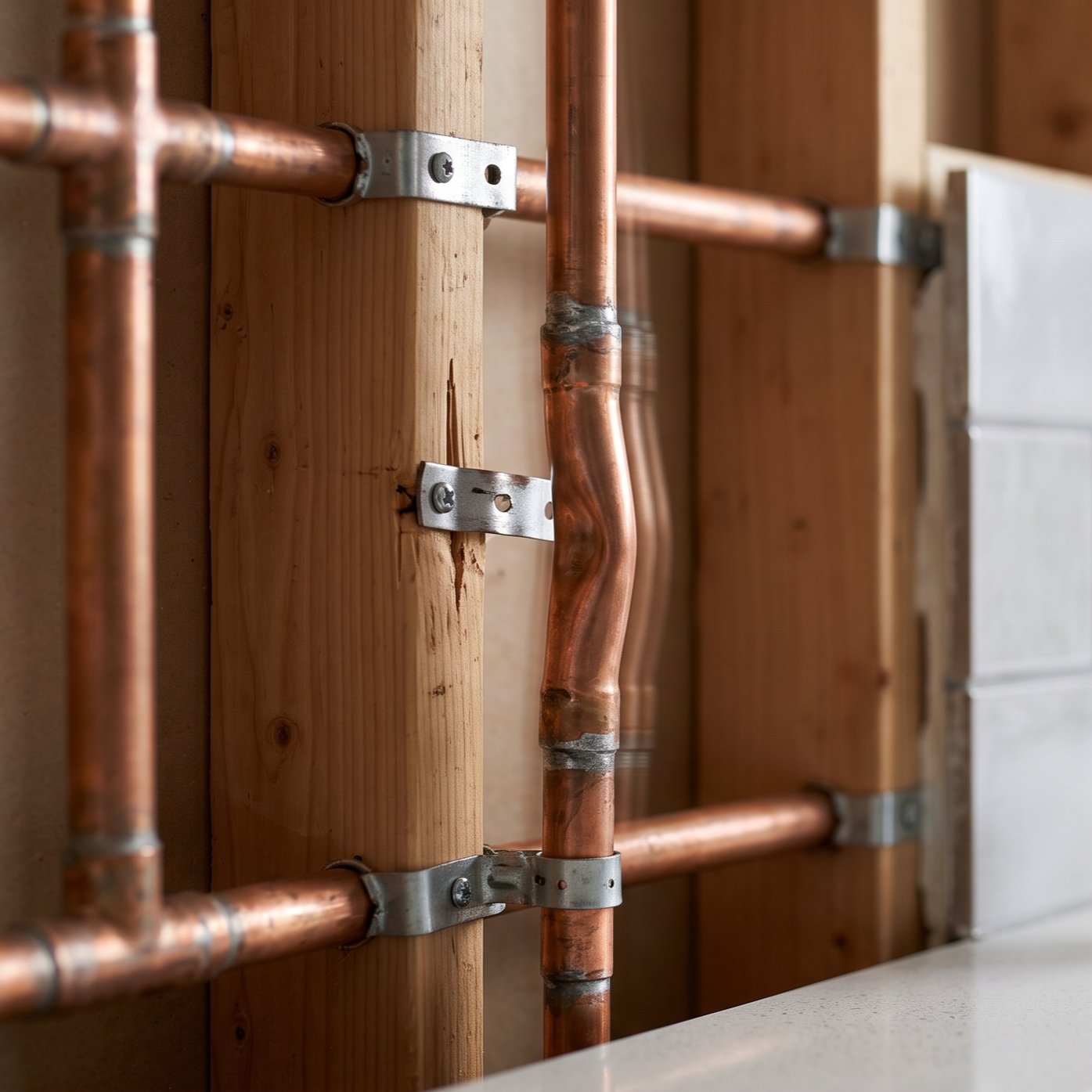
Supply pipes are held to the framing with metal or plastic straps. Over time, a strap can loosen, or the wood can shrink around it, leaving the pipe room to move. When water surges or shuts off, the pipe jumps and knocks against the stud or joist next to it. It sounds like a bang, but the mechanism is different; it is a pipe hitting wood, not a shock wave hitting a valve, and no arrestor will fix it. The tell is that a loose-strap knock often comes when water starts, or changes flow, not only at the sharp moment of shutoff, and you can sometimes trace it to one spot in a wall or under a floor. The fix is to secure the pipe, often with a cushioned clamp, so it cannot rattle again.
Two other pipe noises get confused with the hammer, too. A steady hiss usually means water is passing a partly closed valve or a small restriction, not a shock. A ticking or crackling that fades in and out, often after hot water runs, is thermal expansion: the pipe expands against its surroundings as it warms and contracts as it cools. Neither of those is water hammer, and neither is fixed the same way.
Is It Actually Hurting Anything
In the short term, a single knock will not burst a pipe. The concern is repetition. Every slam is a small impact load on the joints, the solder or crimped connections, and the fittings. Hit any connection thousands of times over the years, and it can work loose, develop a hairline weep, or fail outright. Water hammer is one of those slow problems that stays annoying for a long time and then shows up as a leak inside a wall or under a slab, where the damage stays hidden until it is real. Quieting it is not about noise alone; it protects the connections from a fatigue you cannot see.
Reading the Pattern to Find the Cause
The single most useful thing you can do is pay attention to exactly when the bang happens, because the pattern narrows the cause fast. A bang that lands the instant a valve closes, and only then, is classic water hammer. If it happens at random, when no fixture is shutting off, look harder at loose straps or thermal ticking instead.
Notice which fixture triggers it. If the whole house bangs no matter which faucet or appliance you shut off, the cause is systemwide, waterlogged air chambers across the house, or high pressure feeding everything. If only the washing machine or the dishwasher sets it off, the fast solenoid valve in that appliance is the trigger, and a dedicated arrestor at that appliance is usually the answer. One fixture banging on its own points to a single waterlogged air chamber or a loose run of pipe near it. The noise is diagnostic if you listen to it.
Frequently Asked Questions
A single bang will not burst anything, but repeated shocks are a fatigue problem. Each slam sends an impact through the joints and fittings, and connections are not built to absorb thousands of those hits over the years. Soldered joints can develop a hairline weep, threaded and crimped fittings can loosen, and the failure often appears far from where you hear the noise, inside a wall cavity or, in a slab-on-grade home, in a supply line under the concrete where a leak is hidden and expensive to reach. Loose fittings on a toilet or washer connection can also start to seep. So the banging is worth quieting even when nothing is leaking yet, because it is quietly working against the parts you cannot inspect.
You are draining the whole system so air can refill those capped stubs. Shut off the main water valve where the line enters the house. Then open the highest faucet in the home, usually an upstairs bathroom, and the lowest one, often a basement laundry sink or an outside hose bib, and let every faucet in between run until they all stop dripping and hiss to empty. Flush the toilets too. With the system drained, the waterlogged chambers empty out and draw in fresh air. Turn the main back on, then run each faucet to purge the sputtering air, starting from the lowest and working up. If the banging comes back within weeks, the chambers are likely too small, or the plumbing has none, and mechanical arrestors are the more permanent route.
It is a sealed shock absorber for your plumbing, a small cylinder with a spring-loaded piston or a rubber diaphragm holding a permanent pocket of air or gas behind it. Unlike an open-air chamber, that pocket cannot dissolve into the water, so it keeps cushioning for the life of the part instead of waterlogging. It installs right at the source of the worst shock, most often on the hot and cold supply lines behind a washing machine, where screw-on models thread onto the hose bibs in a few minutes, or tucked under a sink near a dishwasher connection. Placing it close to the fast-closing valve makes it effective, since it catches the shock at the point where the column stops most abruptly.
High pressure does not create hammer by itself, but it applies more force to the water, so every shutoff hits harder and stresses fixtures and valves around the clock. You can check it yourself with an inexpensive water pressure gauge from a hardware store. Screw it onto an outside hose bib or the laundry faucet, make sure no water is running anywhere in the house, and read the dial. A reading in the 40 to 80 psi range is normal; above roughly 80 psi is too high and should be brought down. High pressure usually means the pressure-reducing valve on your main line is set too high, worn out, or missing. Testing is a homeowner’s job but adjusting or replacing that valve is pro work because it governs the whole house.
Those appliances close their water valves with an electric solenoid, a valve that snaps shut in a fraction of a second the moment the machine has the water it needs. That near-instant closure is the worst case for water hammer, far more abrupt than a hand-turned faucet, so an appliance can hammer hard even when the rest of the house is quiet. It is also common right after a new machine goes in, because modern high-efficiency units cycle their fill valves quickly and repeatedly. The targeted fix is a water hammer arrestor on that appliance's supply lines rather than anything systemwide, since the trigger is local to that fast valve.
A change to the system is a common trigger. Adding a fast-closing appliance like a new washer or dishwasher introduces a valve that stops the water hard, and a repipe or a water-heater swap can drain and disturb the old air chambers that used to cushion the shock. There's also a quieter cause: when a check valve, a backflow preventer, or a pressure-reducing valve is added at the meter, the home becomes a closed system that can no longer push pressure back out to the street. Heated water then expands with nowhere to go, spiking the pressure and worsening the banging, which is why a closed system usually needs a thermal expansion tank to absorb it. If the noise showed up right after work was done, that new pressure setup is often the reason, not a coincidence.
If your pipes bang every time a faucet or the washer shuts off, we can check your pressure, recharge or add arrestors, and secure any loose runs before the shock works a joint loose. Adaven Plumbing serves Las Vegas and the surrounding area. Call (702) 766-3320.