
Why All Your Drains Slowed Down at Once (Not Just One)
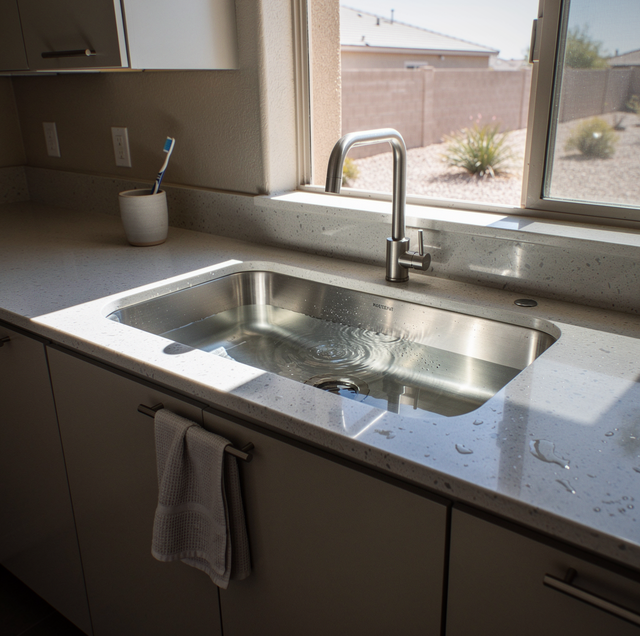
Quick Answer: A single slow drain is almost always a local clog in that fixture's own trap or branch line — hair, soap, food scraps, or something caught near the drain opening. When the kitchen sink, both bathroom sinks, the tub, and the toilet all slow down around the same time, the shared pipe they all empty into is restricted, not any one fixture. That shared pipe is usually the main drain line, and a restriction there affects every fixture that feeds it, which is why the slowdown seems to hit everything at once rather than building up gradually at one spot.
A slow bathroom sink is annoying but easy to explain: hair and soap scum built up in the trap, and a plunger or a drain snake usually sorts it out in minutes. It's a different feeling entirely when the kitchen sink starts draining sluggishly on the same day the shower is standing in an inch of water, and the toilet takes an extra few seconds to clear. That pattern isn't several small coincidences happening together. It's one problem showing up in several places, and figuring out where it actually lives changes everything about how urgent it is and how it gets fixed.
One Slow Drain Means A Local Problem
Every sink, tub, and shower has its own trap and its own short run of pipe before it joins a larger line shared with other fixtures. When only one fixture drains slowly, the obstruction is almost always inside that fixture's own short run: a wad of hair in the tub trap, congealed grease and food in the kitchen line, or a buildup of soap scum narrowing the pipe in a bathroom sink that's used constantly. The water still has somewhere to go; it just has to squeeze past something first, so it drains, only slower than it should.
This kind of clog stays contained because the blockage sits close to the fixture, before that branch ever joins anything shared. Nothing else in the house is affected by it because nothing else routes through that section of pipe. A single slow drain is inconvenient, but it's rarely a sign of a bigger issue building somewhere else.
Why Several Drains Slowing Down Together Is Different
Trace the plumbing far enough, and every fixture's branch line eventually joins a main drain that carries it all out to the sewer connection. That main line is the single point every fixture in the house has in common. When it narrows or partially blocks, water from every fixture upstream of the blockage has to compete for less space to get through, and they all slow down together, even though nothing changed at the fixtures themselves.
That's the real tell. A clog in one sink's trap can never make a toilet on the other side of the house drain more slowly, because the two aren't sharing any pipe near where the blockage is. But a restriction in the main line touches everything that feeds into it, which is exactly why a whole-house slowdown tends to appear all at once rather than creeping up one fixture at a time. The fixtures aren't failing independently; they're all reporting the same downstream problem from different rooms.
What Actually Restricts A Main Line
A few things commonly narrow a main drain enough to slow every fixture connected to it. Grease and soap residue build up in layers along pipe walls over years of ordinary use, gradually shrinking the usable diameter until the line can't keep pace with normal water use. Paper products and wipes that don't break down the way toilet paper does can catch on a rough spot or a slight dip in the pipe and start collecting debris behind them. In neighborhoods with older clay or cast-iron sewer laterals, tree roots can work their way into small cracks or joints and fan out inside the pipe, catching solids and slowing flow long before they block it outright.
Where homes sit on slab foundations, the main line typically runs beneath the slab itself, out to a cleanout and on to the sewer connection. That means the pipe isn't something you can inspect by eye the way you might check under a sink, and a restriction there often isn't obvious until multiple fixtures start acting up on the same day.
Slope And Venting Also Play A Part
A drain line relies on gravity to move water, so it has to fall along a steady, gentle slope from each fixture to the sewer connection. A section of pipe that's settled unevenly, or that was installed with too little pitch, drains more slowly than the rest of the system, even with nothing blocking it, and that slower stretch is exactly where solids tend to settle out and start narrowing the pipe further over time.
Venting matters too, though in a different way. Vent pipes let air into the drain system so water can flow out smoothly instead of fighting a vacuum behind it. A restricted vent, whether by debris or a structural issue, can slow drainage across several fixtures that share it, even without a true blockage in the line. The difference is usually in the details: a venting problem tends to come with gurgling and air movement sounds along with the slow draining, while a plain restriction in the main line tends to just be slow, heavy, reluctant water with no air noise at all.
Reading the Pattern
| What you're seeing | What it usually points to |
|---|---|
| Only one sink or tub drains slowly | Local clog in that fixture's own trap or branch |
| Several fixtures slow down on the same day | Main line restriction shared by those fixtures |
| Slow drains plus gurgling sounds | Venting issue, possibly combined with a clog |
| Toilet is the slowest or backs up first | Main line problem, since toilets have the largest, most direct connection |
| Slow drains getting worse over days or weeks | Buildup narrowing the main line, likely to progress |
The detail worth paying attention to is timing. A single fixture that's been getting slower for a while, on its own, usually indicates a local clog that's worsening gradually. Several fixtures turning sluggish within the same day or two is a much stronger signal that the shared main line is the actual problem, because that pattern is hard to explain any other way.
Why This Is Worth Acting On Quickly
A restriction in the main line rarely stays the same. Every time you run water, flush a toilet, or do a load of laundry, more waste passes through the same narrowed section, and the buildup that's already there tends to accumulate further rather than clear on its own. Left alone, a partial restriction can progress to a full blockage, and a full blockage in the main line leaves wastewater nowhere to go but back up through the lowest drains in the house, which can mean sewage reaching a bathroom or laundry floor rather than staying in the pipe where it belongs.
That's the practical reason a whole-house slowdown deserves a faster response than a single sluggish sink. It isn't that one is dangerous, and the other isn't; it's that one is contained, and the other is actively worsening with continued use. Cutting back on water use in the house, especially longer showers and laundry loads, buys some time until it's looked at, but it doesn't fix the underlying restriction.
Diagnosing And Clearing A Main-Line Slowdown
A plumber typically starts by running a cable or auger from the nearest cleanout to clear an immediate path, then follows with a camera inspection to see what's actually inside the line: grease and buildup along the walls, root intrusion at a joint, an uneven or bellied section holding water and solids, or debris caught on a rough patch. That camera view matters because it tells you whether the fix is a thorough cleaning, a targeted repair at one section, or, for pipe that's deteriorated broadly, a more complete rehabilitation of the line.
Hydro jetting, which uses pressurized water to scour the full inside diameter of the pipe rather than just punching a channel through the middle, is often the better option for grease and scale buildup that's narrowed a line over years, since a cable alone can leave a coating behind that narrows things again fairly quickly. Root intrusion usually calls for a different approach depending on how established the roots are and whether the pipe itself has cracked or separated at a joint, which is exactly the kind of judgment call a camera inspection is built to answer.
When One Fixture Might Still Need Its Own Fix
Not every slowdown that touches more than one fixture is a main-line issue. If a kitchen sink and a nearby bathroom sink both slow down but a toilet across the house drains normally, check whether those two fixtures actually share a branch before assuming the main line is at fault. Two fixtures on the same short branch can slow down together from a clog in that shared branch alone, without the true main line being involved at all. The distinguishing question is still the same one: does the slowdown track with a group of fixtures that share a pipe, or does it show up across fixtures that have nothing in common except the main line and the sewer connection? Once you can answer that, the rest of the diagnosis tends to follow logically.
Frequently Asked Questions
Because they're all feeding into the same main drain line, and a restriction there affects every fixture upstream of it at once. Individual fixture clogs are contained to that one drain, so when several fixtures slow down together, especially within the same day, the shared main line is the far more likely explanation.
Yes, and it's usually a local issue rather than a warning sign. Hair, soap, and food debris commonly build up in a single fixture's trap or short branch line, slowing that one drain while leaving every other fixture unaffected. Clearing that fixture on its own typically resolves it.
More urgent than a single slow drain, because a shared restriction tends to get worse with continued water use rather than staying steady. It won't necessarily turn into a backup overnight, but treating it as a "watch and wait" situation risks a full blockage that pushes wastewater back up through the lowest drains in the home.
Yes, particularly with older clay or cast-iron sewer pipe. Roots enter through small cracks or loose joints and spread out inside the pipe, catching solids and narrowing the usable space for water to pass. A camera inspection is a reliable way to confirm root intrusion rather than other causes of a main-line restriction.
Cabling uses a rotating cable to punch or cut through a blockage, opening a path but sometimes leaving buildup on the pipe walls. Hydro jetting uses pressurized water to scour the entire inside diameter of the pipe, removing grease and buildup more completely, which tends to make it a better fit for a line that's narrowed gradually over time rather than one with a single obstruction.
Cutting back on water use, particularly on longer showers and laundry, is a reasonable step while you're waiting for the line to be checked, since it slows how quickly a restriction can turn into a full blockage. It isn't a fix on its own, and a slowdown across multiple fixtures is worth having inspected rather than managed indefinitely.
A single slow drain is a fixture problem; several slow drains at once are a system problem, and the fastest way to tell them apart is to notice whether the slowdown is isolated or shared. Once several fixtures with nothing in common but the main line start acting up together, the smart move is a camera inspection rather than another round of plunging one sink at a time.
More than one drain running slow at once? — Get the main line camera-inspected before a restriction turns into a backup. Adaven Plumbing serves Las Vegas and the surrounding area. Call (702) 766-3320.