
A Faint Gas Smell Near the Stove: What to Check First
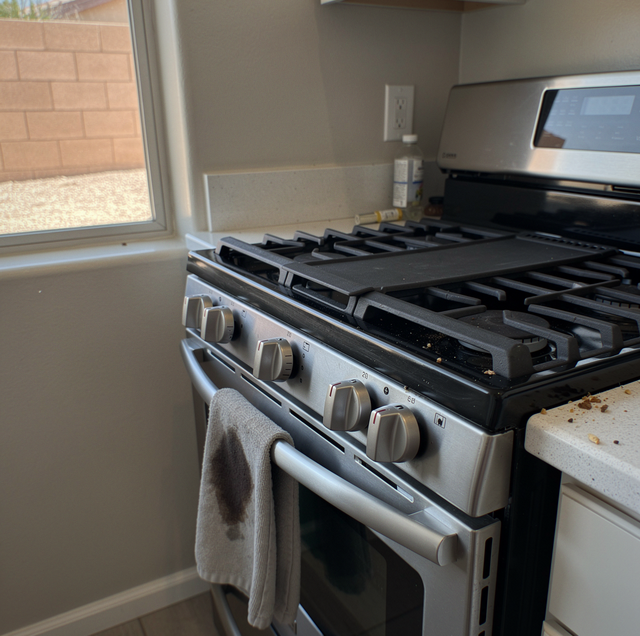
You catch it for half a second while reaching past the range for a dish towel. Something faintly sulfurous, like a struck match or an egg that turned, gone before you can be sure it was there. An hour later it returns, just as brief. No hiss, no flame, no warning light. The question is whether this is worth mentioning to somebody eventually, or handling in the next ten minutes.
Quick Answer: Natural gas has no smell of its own. The rotten-egg odor comes from an added odorant so leaks are detected well below the point where gas can ignite. A single faint whiff near a stove that clears in seconds and never returns is often a burner that took an extra moment to light, or a knob nudged off its stop. A smell that lingers, keeps returning, or grows even slightly is a different situation: get everyone out, do not touch light switches or appliances on the way, and call the gas utility's emergency line and a licensed plumber from outside. Do not hunt for the source yourself, and never use a flame to test anything.
The Smell Is Added on Purpose
Natural gas coming out of the ground has essentially no odor. Methane, its main component, is colorless and scentless, which for most of the era of piped gas meant a leak announced itself the hard way. Gas distributed to homes now carries an odorant, most often a mercaptan (a sulfur-bearing compound) or a blend of mercaptans and related sulfides, injected at a tiny concentration before the gas reaches neighborhood mains.
The particular smell is a deliberate choice. Mercaptans read as rotten eggs, sulfur, skunk, or spoiled cabbage, and the human nose is unusually sensitive to that family of compounds. The odorant is a smoke alarm dissolved into the fuel: it does nothing to make the gas safer; it only makes it impossible to ignore.
Natural gas burns only when it makes up roughly five to fifteen percent of the air in a space. Below that band the mixture is too lean to catch, above it too rich. Utilities generally set odorant levels so a person with an ordinary sense of smell notices gas at around a fifth of that lower flammable limit. You are meant to smell a leak long before a room can ignite. Faint is the design, and it is the early part of the curve, not the harmless part.
Where a Faint Smell Near a Range Usually Comes From
A stove is the one place in a house where gas is released and burned on purpose several times a day, so small interruptions there can produce a brief odor. A few causes account for most of them.
A burner that took an extra second to light
Most current ranges use an electric spark igniter rather than a standing pilot. Turning the knob opens the valve, and the igniter clicks until the gas catches. If the burner ports are partly blocked by boiled-over food, or the igniter is damp after a spill, the gap between the valve opening and the flame widens, and a small volume of unburned gas escapes into the room. It clears within seconds once the flame establishes. Repeated clicking, or a burner needing several tries, points to a burner assembly due for cleaning or a weakening igniter.
A burner cap sitting off its seat
Each surface burner has a removable cap that directs flame outward through the ports, and after cleaning it is easy to set one down rotated or off-center. The flame pattern becomes uneven or yellow-tipped, combustion runs incomplete, and the burner emits an off odor only during use, not while the stove sits idle.
A knob that never fully returned to off
Range knobs have a detent, the stop you feel as a click at the off position. They get bumped by a hip, caught by a sleeve, or nudged while someone wipes the front panel. A knob just off its stop can hold the valve barely open with no flame and no sound, which makes it a common source of a smell with no visible cause.
The connector and shutoff behind the range
A range ties into the home's gas piping through a flexible appliance connector, usually coated corrugated stainless steel, with flare fittings at each end and a shutoff valve on the wall behind the unit. That connector, those fittings, and the packing around the valve stem are the parts most likely to weep gas as they age, and this is the area you should least be poking at. Nothing in that assembly is a homeowner check, at any smell level.
Reading the Smell: Three Levels, Three Responses
The useful question is not what is leaking. It is how far past "momentary" the smell has gotten.
A single faint whiff that clears in seconds and does not return: This matches a burner that lit slowly. From where you stand, look: are all the knobs seated at their off-click, is any burner still ticking, is something simmering over? Returning a knob that is visibly off its stop is ordinary stove operation rather than gas work, and is reasonable once the air has cleared. If any doubt remains about whether the air is clear, skip the look and go straight to the next paragraph. Mention it the next time a plumber is in the house, and note whether it repeats.
A faint smell that keeps coming back, or hangs around with every burner off: Stop checking and start leaving. A smell that persists with nothing burning means gas is entering the room from something other than a just-lit burner, and the odor alone will not tell you whether the source is the connector, a flare fitting, the valve packing, the appliance regulator, or piping inside a wall. Get everyone out, pets included, and call the gas utility's emergency number and a licensed plumber from outside. Utilities dispatch on a reported odor at any hour, and would far rather answer a false alarm than a late one.
A strong smell, an audible hiss, or anyone feeling unwell: Leave immediately without stopping to investigate anything. Headache, dizziness, nausea, and a lightheaded, unfocused feeling can accompany gas displacing oxygen in a closed room, and judgment is among the first things affected. Do not collect belongings, do not go back inside for any reason, and call 911 and the utility once you are well away from the building.
Actions That Turn a Small Leak Into a Serious One
Almost every item below is something a reasonable person does while trying to be helpful.
Do not operate any switch or electrical device: Light switches, a range hood fan, a ceiling fan pull chain, a garage door opener, a doorbell, a thermostat, and a plug pulled from an outlet all produce a small arc inside the contacts, and in a room where gas is collecting, that arc is an ignition source. Switching something off sparks the same way, so leave every switch as you found it and make the call from outdoors rather than from the kitchen.
Do not light anything to find the source: No match, no lighter, no candle, no burner turned on to "see if it is working."
Do not pull the range out to look behind it: Sliding a range flexes the appliance connector at exactly the bends that have work-hardened over years of sitting still, and a connector weeping a trace can crack open into a real leak the moment it bends. Moving appliances to inspect behind them is a recognized way to create a new leak, which is why that space belongs to a technician.
Do not brush soapy water on fittings: The bubble test is a valid method, but a technician performs it after the gas has been isolated at the correct valve and the area has been made safe, knowing which joints are live. Doing it while a smell is present puts your face inches from a suspected leak.
Do not tighten anything: Flare fittings on gas connectors seal by metal-to-metal contact against a machined face, and over-tightening deforms that face and turns a small weep into a larger one. Gas joints get torqued to spec and leak-tested by someone who does it for a living.
Do not decide it needs airing out: Opening a window lowers the concentration and changes nothing about the source. Ventilation is something you do on your way out, not instead of going out.
How the Source Actually Gets Found
Two responders handle two halves of this, and knowing which is which saves confusion.
The gas utility treats a reported odor as an emergency call. Their technician surveys with a combustible gas indicator, a handheld instrument reporting gas concentration in air as a percentage of the flammable limit, far more precise than any nose, and walks the meter, the service line, and the appliances. If a leak occurs on the customer side of the meter, they typically shut off the gas there and tag or lock it until a repair is made and verified. Their responsibility generally stops at the meter, and the piping and appliances beyond it belong to the homeowner.
The licensed plumber handles that side. The work usually begins by isolating the section in question and placing a gauge on it, watching for any drop over a set period, which helps distinguish a leaking appliance connection from a leak in the fixed piping. From there it narrows: leak-detection solution on accessible joints, an electronic sniffer along runs that are awkward to reach, an inspection of the connector and its flare nuts, and a look at the shutoff valve stem packing, a frequent and easily missed source. Repairs run from a new connector and fittings to cutting out a section of black iron or corrugated stainless piping, and everything gets pressure-tested before gas goes back on. Worth raising with whoever does the work: uncoated brass appliance connectors made before the mid-1970s have a known failure mode, cracking at the threaded joint, and consumer-safety agencies have urged their replacement for decades.
A Smell You Should Never Get Used To
The usual failure with a faint gas odor is not panic. It is habituation. Someone notices it Tuesday, mentions it Thursday, stops mentioning it the following week, and by month's end the smell has become part of the kitchen. Nobody decided to ignore it. It stopped registering as new information.
Gas appliances see heavier use in cold months, so a weak connection often gets noticed then, but a house closed up with air conditioning running holds an odor just as well in hot weather. That pattern reflects how often you stand in the kitchen, not the condition of the fitting. A joint that weeps does not heal on its own, and the response to a repeating smell is the same in any month: leave, call, and let someone with an instrument answer the question your nose only raised.
Frequently Asked Questions
Olfactory fatigue. The nose desensitizes to mercaptan within minutes of continuous exposure, so a fading smell is not evidence the gas is clearing. A head cold, allergies, smoking, and some medications all blunt detection, and a minority of people carry a reduced inherited sensitivity to sulfur odorants. It is why someone walking in from outside notices what those already inside no longer register.
Yes, and the effect has a name: odor fade. The odorant can adsorb onto the interior walls of new, rusty, or recently installed steel pipe, so gas arriving at the far end is under-odorized until the pipe conditions. Gas escaping from a buried line and filtering up through the soil can also lose much of its odorant to the soil. Neither is common indoors, but both are why a gas alarm is a real backup to a nose rather than a redundancy.
No. A carbon monoxide alarm senses a different gas entirely, one produced by incomplete combustion rather than raw fuel escaping. A methane alarm is a separate device, and mounting height matters because the two fuels behave in opposite ways: natural gas is lighter than air and pools near the ceiling, so its alarm belongs high on the wall, while propane is heavier and its alarm belongs low. A home with a gas range and a propane appliance needs both placements.
Usually not, for two separate reasons. A new or recently self-cleaned oven burns off manufacturing oils, coatings, and residue during its first several heat cycles, resulting in an acrid, chemical odor rather than a sulfurous one. Separately, many ovens use a glow-bar igniter rather than a spark, and that bar must heat for roughly 30 to 90 seconds before it draws enough current to open the safety valve, so a trace of gas odor at the start of a preheat is more typical of ovens than of burners. A glow bar weakened with age lengthens that delay and is a routine wear part.
No, and it should never delay leaving. The main valve at the meter generally needs a wrench, is not always accessible, and once shut off there, the gas should only be restored by the utility or a qualified technician, because every appliance control and pilot has to be checked and relit and the system re-tested first. The shutoff behind the range is a different valve serving only that appliance. Neither is a first step. Getting out and making the call is.
It can, though it should be treated as gas until someone confirms otherwise. A P-trap in a rarely used floor drain or guest bath can evaporate dry within weeks and let sewer gas rise into the room. A hydrogen sulfide reaction inside a water heater gives off a rotten-egg odor, but only at hot-water taps. A rodent dead in a wall cavity or produce forgotten in a low cabinet can both read as sulfurous. None of those carries risk in the minutes it takes to rule out gas first.
Schedule a gas line inspection — have a licensed plumber pressure-test the line and locate the source of a recurring smell. Adaven Plumbing serves Las Vegas and the surrounding area. Call (702) 766-3320.