
White Crusty Buildup on Faucets: The Warning You Shouldn’t Wipe Away
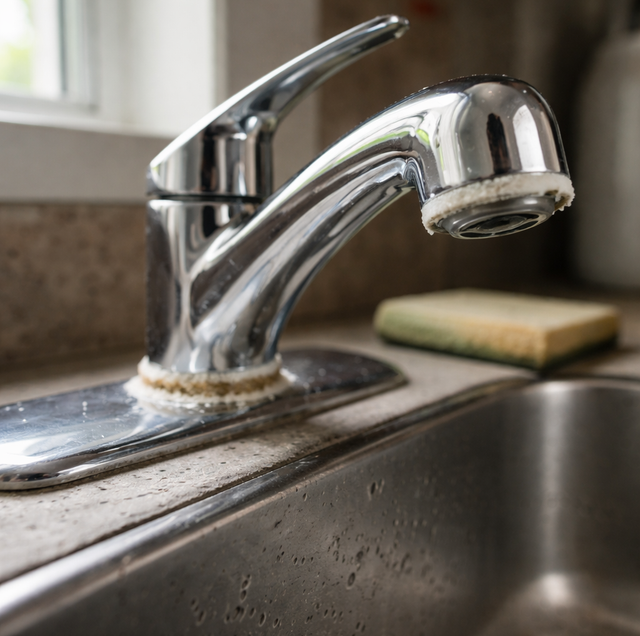
Quick Answer: The white, chalky crust around faucets and showerheads is mineral scale, mostly calcium and magnesium left behind when hard water evaporates or gets heated. It is a visible sign that the same minerals are collecting inside your fixtures, pipes, and water heater, where you cannot see them.
You wipe the counter, and a few days later the base of the faucet has a dull white ring again. The showerhead grows a crust around its nozzles. The shower glass hazes over no matter how hard you squeegee. It looks like a cleaning problem. It is really a water problem, and the crust is the one part of it you can actually see.
What The White Crust Actually Is
Tap water is rarely just water. It carries dissolved minerals it picked up as it moved through rock and soil, and the two that matter most here are calcium and magnesium. While they stay dissolved, the water looks and pours completely clear. The trouble starts when the water leaves and the minerals do not.
Two things strand those minerals as a solid. The first is evaporation: a droplet clings to the spout, the water floats off into the air, and the calcium and magnesium it was carrying have nowhere to go but the metal. The second is heat: warm water holds less dissolved mineral than cold, so heating the water forces some of it to drop out. That is why the crust is worst exactly where water sits and dries or where it runs hot, at the faucet tip, around showerhead nozzles, on the shower door, and along the rim of the tub.
The deposit itself is scale, often called limescale. It is largely calcium carbonate, the same family of compounds as chalk and eggshell, which is why it scratches off as a soft powder at first and hardens into a stubborn gray-white shell if it is left to build in layers.
Why it keeps coming back after you clean it: Wiping the crust away does nothing to the water still arriving through the pipe. Every glass poured, every shower taken, every cycle of the dishwasher delivers a fresh dose of the same minerals, and a fraction of them stay behind again. The buildup is not a one-time mess. It is a slow, steady deposit that renews itself as long as the water feeding the house stays hard.
What It Signals About Your Water
The crust is a hardness gauge you did not have to buy. Water hardness is measured in grains per gallon, and the higher that number climbs, the more minerals each gallon drops out and the faster the white film returns. Soft water leaves almost nothing behind. Very hard water can coat a clean fixture in days.
If you are seeing crust form quickly, growing on nearly every fixture, and hazing the glass shower enclosure, the water feeding your home sits well up the hardness scale. Water drawn from mineral-rich groundwater or certain surface sources tends to run hard year-round, and hardness does not take a season off. It is not a summer or winter issue. The same dissolved minerals arrive in January and July alike, so this is a condition to manage continuously rather than wait out.
The visible crust is also a stand-in for everything you cannot see. The faucet tip is just the sampling point. Whatever is plating onto the outside of the spout is plating onto the inside of the plumbing at the same rate.
Where The Buildup Shows Up
Scale does not coat a home evenly. It piles up in a handful of predictable spots, and knowing them tells you how far along the problem is.
Aerators and faucet tips: The little screened cap on the end of most faucets is called the aerator. It mixes air into the stream to soften the splash and hold down splatter. Its fine screen is a perfect trap for flakes of scale, and it clogs from the inside. A faucet that has lost pressure or now sprays sideways in an odd fan pattern usually has an aerator packed with mineral grit.
Showerheads: Each nozzle on a showerhead is a small opening where water pauses, then dries between uses, the ideal recipe for scale. As nozzles crust over, the spray narrows to a few thin, stinging jets while others quit entirely. A showerhead losing nozzles one by one is charting your water's hardness for you.
Fixtures and glass: Chrome handles, spouts, and the base rings of faucets collect the dull white film that will not polish out. Shower glass is the most visible casualty. The etched, cloudy look that survives every cleaner is mineral film bonded to the surface, and once it has etched into the glass itself, it may not come fully clean again.
The Damage You Cannot See
Cosmetic crust is the mild version. The same process runs everywhere hard water flows, and the hidden deposits are what cost real money.
Scale narrows pipes from the inside like plaque in an artery, shrinking the channel water moves through and dragging down flow at every tap. It coats the inside of the water heater, where the constant heat drives deposition hardest of all. In a tank heater, the scale settles to the bottom as a crusted layer that insulates the water from the burner or element below it, so the unit works longer and harder to hit the same temperature. In a tankless unit, scale narrows the very passages the water is heated in and is a leading reason those systems lose output and shut down on fault codes.
Every water-using appliance is exposed to the same load. Dishwashers, washing machines, ice makers, and coffee makers all run hard water through fine internal parts and heating elements, and scale shortens the life of each. The white crust on the faucet is the early, visible warning that this quieter wear is already underway inside the walls and behind the appliance panels.
How To Clean Scale Off What You Can Reach
The good news is that the parts fouling first are usually the parts you can service yourself. Mild acid dissolves calcium carbonate, and household white vinegar is acidic enough to do the job with patience.
Aerators: Most aerators unscrew from the faucet tip by hand or with gentle plier grip padded by a cloth so you do not mar the finish. Take the assembly apart, keep the small pieces in order, and soak them in white vinegar until the deposits soften, which can take from twenty minutes to a few hours depending on the buildup. A soft brush or an old toothbrush clears the loosened grit, and a rinse and reassembly restores the flow. Badly clogged aerators are inexpensive to replace.
Showerheads: If the showerhead lifts off easily, soak it in a bowl of warm vinegar the same way. If it does not, fill a sturdy bag with vinegar, slip it over the head so the nozzle face is submerged, and secure it with a tie or rubber band overnight. Work each softened nozzle with a thumb or brush afterward to free the openings, then run the shower hot for a minute to flush the loosened debris.
White vinegar is acidic enough to dissolve calcium scale with patience. Unscrew aerators and soak the pieces until the deposits soften, and for a showerhead that will not come off, tie a bag of vinegar over the nozzle face overnight, then work each opening free with a brush.
Fixtures and glass: A cloth dampened with vinegar and laid against a crusted spout for several minutes softens the film so it wipes rather than scrapes. Test any acidic cleaner on a hidden spot first, since some finishes and natural stone do not tolerate acid.
For anything sealed inside the system, the tank or tankless water heater, softener plumbing, or the main line, the work moves from wiping a part to opening the plumbing, and gas and electric connections raise real safety stakes. Flushing and descaling a water heater or installing equipment on the main line is a job for a licensed plumber.
How To Stop The Crust From Coming Back
Cleaning treats the symptom. Prevention treats the water, and there are two broad routes.
A water softener removes the calcium and magnesium before they ever reach a faucet, typically by ion exchange, swapping the hardness minerals for sodium or potassium as water passes through a resin bed. With the minerals gone, the water has nothing to deposit, and the crust stops forming across the whole house. That whole-home reach is the point. It protects the water heater and the pipes, not only the fixtures you can see.
A whole-home water conditioner is the other path. Rather than stripping the minerals out, conditioners alter how they behave so they are far less likely to stick and harden into scale. The minerals stay in the water, but they pass through instead of plating onto surfaces. Which approach suits a given home depends on the water and the household, and because either one ties into the main supply, sizing and installation are work for a professional.
There is a housekeeping habit that helps in the meantime. Because most scale forms as water dries, wiping glass and fixtures after use removes droplets before they can leave minerals behind. It will not touch the hidden deposits inside the plumbing, but it keeps the visible surfaces clearer between deeper cleanings.
Frequently Asked Questions
The calcium and magnesium behind the crust are not considered a health hazard in drinking water, and hardness is regulated as a secondary, aesthetic characteristic rather than a contaminant. Hard water is judged on its effects on plumbing and cleaning, not on safety, which is why a home can have very hard water that is still perfectly fine to drink.
Yes, and those spots are the same minerals in a thinner form. When hard water dries on glass, it leaves a flat film rather than a crust, and dishwashers make it worse by heating and evaporating the water fast in the drying cycle. A rinse aid helps because it breaks the surface tension so water sheets off the dish instead of beading up and drying in mineral-laden droplets.
You can, and commercial descalers are usually stronger acids that work faster than vinegar on heavy buildup. The trade-off is that they are harsher on finishes and skin, so follow the label for contact time and ventilation, and keep them off natural stone, aluminum, and some coated metals that acid can pit or discolor.
Many people notice a soft, slick feel to softened water in the shower, and that is normal rather than a sign of leftover soap. Without the hardness minerals to bind with soap and form the sticky curd known as soap scum, lather rinses more completely, and the bare feel of clean skin is what registers as slippery.
It can be either, and where the drop shows up is a clue. A single slow faucet usually means a clogged aerator or supply line at that spot, which is a local fix. Weak flow at many fixtures at once points to scale narrowing the shared pipes deeper in the system, a whole-house issue that a professional should evaluate.
Sediment and scale buildup at the bottom of a tank heater force the unit to run longer to overcome the insulating layer, which raises wear and energy use, and it is a common reason a heater fails years before it otherwise would. Manufacturers often call for periodic flushing to clear that sediment, and skipping it in hard-water conditions is a frequent cause of early tank failure and rumbling or popping sounds from the tank.
Have your water and heater checked before scale does lasting damage — protect your fixtures, pipes, and appliances. Adaven Plumbing serves Las Vegas and the surrounding area. Call (702) 766-3320.