
Whole-House Filter vs. RO at the Tap: Which One Do You Need?
Quick Answer: A whole-house filter treats every drop entering the home, cutting sediment, chlorine, and scale-forming minerals before they reach a water heater, dishwasher, or fixture. A point-of-use reverse osmosis system sits under one sink and polishes just the water used for drinking and cooking, removing dissolved solids a whole-house filter can't touch. Most homes with poor-quality supply water end up running both: one for the plumbing system, one for the glass.
Two homeowners can describe the exact same symptom- cloudy ice cubes, a chlorine smell at the faucet, white crust building up around the aerator- and need two completely different fixes. One family just wants water that doesn't taste or smell like a swimming pool when they fill a glass. The other is replacing a water heater every six years because scale keeps eating the tank from the inside. Both problems are lumped together as "water quality," but they require different equipment, and buying the wrong one leaves the actual issue untouched.
What A Whole-House Filter Actually Treats
A whole-house filter is installed on the main line where water enters the home, usually right after the shutoff valve, so every fixture, appliance, and hose bib downstream receives treated water. Most systems use a sediment stage first, a fine mesh or spun-poly cartridge that catches sand, rust flakes, and pipe scale before they can score valves and clog aerators. Behind that sits a carbon stage, which removes chlorine and chloramine from the supply, along with the associated taste and odor. Some setups add a dedicated water softener or a scale-reduction cartridge specifically for hardness minerals, since carbon alone doesn't touch calcium and magnesium.
What a whole-house system does not do is remove dissolved solids at a molecular level. Carbon and sediment filtration are designed to remove particles, chlorine byproducts, and organic compounds, not to strip out the minerals that make water "hard" or any trace-level heavy metals. That's a job for a softener or a reverse osmosis membrane, not a carbon block.
What Reverse Osmosis At The Tap Actually Treats
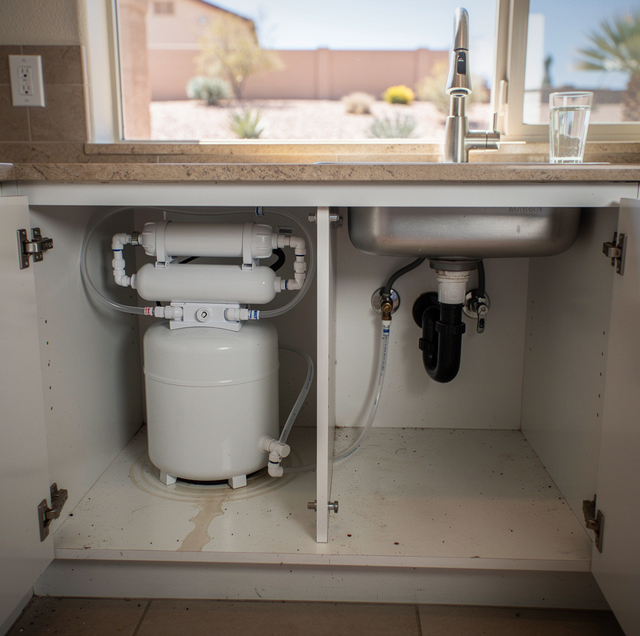
Point-of-use reverse osmosis is a different mechanism entirely. Water is forced through a semi-permeable membrane with pores small enough to block dissolved minerals, salts, lead, and many other contaminants, which pass straight through a carbon filter untouched. Because that membrane is slow and only makes sense for the water you actually drink and cook with, RO units are almost always installed under a single sink, feeding a dedicated faucet and sometimes an icemaker line, rather than treating the whole house.
Most RO systems still include a sediment pre-filter and a carbon stage ahead of the membrane, both to protect the membrane from clogging and to strip chlorine before it reaches the delicate filter media. The membrane itself is the part doing the heavy lifting on dissolved solids, and it's also the part with the lowest flow rate and the shortest service interval in the whole stack.
Water Pressure And Flow: Where Each System Costs You
A whole-house filter has a minor, usually unnoticeable effect on pressure. A clean sediment and carbon cartridge, sized correctly for the home's flow rate, adds only a small pressure drop, similar to what you'd lose by running an extra length of pipe. The bigger risk is a cartridge that's overdue for a change: as sediment loads up in the pre-filter, flow across the whole house can drop noticeably, showing up as a weaker shower or a dishwasher that takes longer to fill.
Reverse osmosis works on a slower timeline by design. The membrane's pores are so fine that water has to be pushed through under pressure, and even a well-sized residential unit produces only a trickle compared to a fully open tap, which is why RO output nearly always feeds into a small storage tank under the sink rather than delivering water on demand. That's fine for filling a glass or a pot, since the tank holds a reserve, but it means an RO system was never meant to supply a shower, a washing machine, or the rest of the house; trying to run whole-home volume through a membrane built for a single faucet would take it far past what the system can support.
Waste Water Is The Real Trade-Off With RO
This is where the two systems diverge the most. A whole-house filter produces essentially no wastewater; water flows through the cartridges and out to the fixtures, just as it would through bare pipe. Reverse osmosis, by contrast, sends a portion of the water that enters the membrane out to a drain rather than to the storage tank, because pushing water through a membrane that fine means concentrating the rejected minerals somewhere, and that somewhere is a wastewater line. Older or poorly matched RO units can send several gallons down the drain for every gallon of purified water produced; better-designed systems with a permeate pump or a tighter membrane ratio narrow that gap considerably, but some reject water is inherent to how the technology works, not a flaw specific to one brand.
That trade-off is one of the clearest reasons RO stays a point-of-use system. Running that same reject ratio across every gallon used by a whole household, laundry, bathing, and irrigation included, would be an enormous and unnecessary amount of water lost to the drain for water that never needed membrane-level treatment in the first place.
Maintenance And Filter Changes
A whole-house system typically has one or two cartridges to track: sediment and carbon, sometimes combined into a single stage. Change intervals depend heavily on the home's water quality and household usage, so pay attention to actual pressure and flow rather than a fixed calendar date, since a household running well water with heavy sediment will load a pre-filter far faster than one on a clean municipal supply. Softener resin or scale-control media, when present, work on a longer cycle and mostly need salt refills rather than cartridge swaps.
An RO system has more stages to track and a shorter interval on the part that matters most. The sediment and carbon pre-filters usually get swapped on a schedule similar to that of a whole-house system, but the membrane itself has a longer, separate service life and needs periodic testing rather than a simple visual check, since a membrane can gradually lose effectiveness while the water still looks and tastes fine. The storage tank's air bladder can also lose pressure over years of use, which shows up as slow refill or reduced flow at the RO faucet even when every filter stage is fresh.
Where Each System Actually Makes Sense
Think about what problem you're solving before comparing equipment. A whole-house filter is the right call when the concern is protecting plumbing and appliances: scale building up inside a water heater, chlorine odor coming from every tap, sediment scoring valves and clogging aerators throughout the home. It's a system-wide fix for a system-wide symptom, and it does nothing extra for the handful of gallons you actually drink each day beyond what it does for the rest of the house.
Point-of-use reverse osmosis is the right call when the concern is specifically about drinking and cooking water quality: taste, dissolved solids, or contaminants that a carbon filter can't remove. It won't protect a water heater from scale, and it won't stop chlorine smell in a shower, because it was never plumbed to reach either one. Many homes on hard, heavily treated municipal water end up installing both a whole-house system to protect the plumbing and appliances and an RO unit under the kitchen sink to polish the water that actually goes into a glass, since each one solves a problem the other was never designed to address.
Comparing Whole-House Filtration And Point-Of-Use RO
| Factor | Whole-House Filtration | Point-of-Use Reverse Osmosis |
|---|---|---|
| What it removes | Sediment, chlorine/chloramine, taste and odor; some models add scale/hardness treatment | Dissolved solids, salts, lead, and other contaminants a membrane can block, plus what its carbon pre-filter removes |
| Water pressure and flow | Minor drop when cartridges are fresh; noticeable loss if overdue for a change | Slow membrane output feeding a storage tank; not built for whole-home volume or on-demand flow |
| Waste water | Essentially none; water passes through like bare pipe | A portion of input water is sent to the drain as reject water; ratio varies by system design |
| Maintenance | One or two cartridges (sediment, carbon); softener resin needs salt refills | Sediment and carbon pre-filters on a shorter cycle, plus a longer-interval membrane and periodic tank check |
| Best fit | Protecting plumbing, water heater, and appliances house-wide | Polishing drinking and cooking water at one tap |
Reading Your Own Water Before You Choose
The clearest way to tell which one you need, or whether you need both, is to separate the symptoms by where they show up. Scale on faucets, a water heater failing early, chlorine smell across every fixture, and sediment fouling aerators throughout the house all point toward a whole-house solution, because they're system-wide symptoms with a system-wide cause. A taste or odor concern that only bothers you at the drinking glass, or a known dissolved-solids issue turned up by a water test, points toward point-of-use RO instead, because that's a concern about the water you consume rather than the water the plumbing handles.
A water test that breaks down hardness, chlorine residual, and total dissolved solids separately gives a clearer answer than guessing from symptoms alone, since hardness and chlorine call for a whole-house approach while a high dissolved-solids reading or specific contaminants call for RO at the point where you actually drink the water. That test result, more than any general rule, should decide whether one system meets the need or whether the two are meant to work together.
Frequently Asked Questions
No. A standard whole-house sediment and carbon setup is not built to remove dissolved solids or trace contaminants the way an RO membrane does; it addresses taste, odor, chlorine, and particulates, not the mineral load an RO system targets. Some whole-house configurations add a final carbon polishing stage, but even that stops well short of what a membrane strips out.
Yes, an RO membrane is non-selective and removes both wanted and unwanted dissolved minerals as it filters, including calcium and magnesium along with contaminants. Some RO setups add a remineralization cartridge after the membrane to reintroduce a small amount of mineral content for taste; it is an optional add-on rather than a standard part of every system.
Older or poorly matched systems can send three to five gallons to the drain for every gallon of purified water, while newer designs using a permeate pump can narrow that closer to one-to-one or better by recovering pressure that would otherwise be wasted. The exact ratio depends on the membrane's rating, incoming water pressure, and whether the system includes pressure-recovery hardware.
A correctly sized cartridge causes a pressure drop of only a few PSI when it's fresh, similar to what a long run of undersized pipe would cause. The pressure loss that homeowners actually notice almost always traces back to an overdue cartridge clogged with sediment, not to the filtration stage itself operating as designed.
Possibly, since carbon filtration targets chlorine, taste, and odor, not hardness minerals. Calcium and magnesium pass straight through a standard carbon or sediment cartridge, so a household dealing with scale on fixtures or inside a water heater typically needs a dedicated softener or scale-reduction stage added alongside, not instead of, the carbon filter.
A single RO unit's storage tank and membrane are sized for one dedicated faucet's typical draw, so feeding a second sink from the same unit usually means the tank refills more slowly and can run low during heavier use, such as filling several large pots back-to-back. Larger-capacity membranes and tanks are available for households that want RO water at more than one location, but that's a sizing decision made up front, not something added to a single-faucet system after the fact.
Not sure whether a whole-house filter, an RO system, or both fit your water — get a water test and a straight answer. Adaven Plumbing serves Las Vegas and the surrounding area. Call (702) 766-3320.